
 de
Case study
How the aczepta group moved its IT to open standards
Seven locations, around 400 employees, an IT landscape that had grown over the years – and a management team that wanted a clear picture of what it depended on.
 aczepta Sozialbetriebe GmbH
The starting point: a familiar problem

aczepta's IT landscape had grown over the years and looked like that of many social care organizations: virtualized servers, a commercial email system, and licensed software for backup, firewall and spam filtering. Annual license costs were around €45,000 – and rising. This hit home when the vendor of their virtualization software changed its pricing model after a corporate acquisition and raised costs significantly.
For management, this was the trigger to ask a more fundamental question: How dependent is the organization on the pricing and product decisions of individual vendors? And what happens if those conditions change again?
Today, this question is no longer only about costs. US sanctions and trade policy decisions can affect European customers at short notice. How far this can go became clear in 2025 with the International Criminal Court: after the US imposed sanctions on its chief prosecutor, Microsoft blocked his email account – and his bank accounts and credit cards were frozen at the same time. For a care provider operating around the clock, core systems that someone else can switch off are no foundation to build on.
The decision: open standards on its own servers
aczepta decided to replace the licensed products with open source software. It is free of license fees, maintained by developer communities worldwide and runs on the organization's own hardware – nobody can switch it off remotely or change the terms of use unilaterally. Because it is built on open standards, the organization is not locked in when it comes to operations either: the systems can be managed in-house or by different service providers.
Three goals guided the project: significantly reduce operating costs, become more independent of individual vendors, and keep sensitive care and HR data within the organization's own infrastructure. One condition was non-negotiable: ongoing care operations must not be affected at any point.
The process: understand first, then migrate
The project did not start with a software decision but with an inventory: Which systems are in use, which licenses and contracts are in place, which workflows depend on which system? Together with Compli Work, aczepta then decided what to replace – and what to keep.
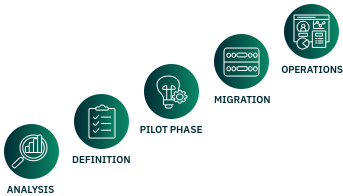
The migration itself was carried out step by step over several months. Each new system was first set up in parallel to the legacy system, tested with real data and only put into production after successful verification. No switchover fell into a critical operating phase, and every step was announced in advance. As a result, IT remained available throughout the entire migration – there was no downtime.
For employees, little changed in their daily work: email, calendars and shared files work as before, just on a different technical foundation – deliberately so, because a migration that overwhelms staff with new interfaces would not have been acceptable in day-to-day care work.
The architecture at a glance
The core of the new infrastructure is Proxmox VE as the virtualization platform. The Windows terminal server for the industry-specific software continues to run there as a virtual machine, complemented by Nextcloud, the mail server (Postfix/Dovecot with upstream spam protection and email archiving) and central OpenLDAP authentication as additional VMs and containers.
A firewall provides perimeter protection between the employees' notebooks and this internal infrastructure. Access is only possible via a VPN behind this firewall: each notebook first establishes the VPN connection before authenticating via OpenLDAP – only then is the way to cloud, mail and care software open. Direct connections bypassing the firewall no longer exist.
The result
–82%
License costs
€37,000
Savings per year
0
Downtime
Once the migration is complete, annual license costs drop from around €45,000 to €8,000. The remaining costs are mainly for commercial components that are still in use. Around €37,000 per year no longer goes into licenses – money that is now available for care itself.
Beyond the savings, aczepta is now in a much stronger position: the data resides on its own servers, operations are no longer tied to individual vendors, and open standards make future projects easier – such as connecting new specialized software or digital communication channels with relatives.
“We had great respect for switching systems during live operations and put it off for a long time. Looking back, our concerns were unfounded. The migration went smoothly, and today we have a solution without ever-increasing license costs.”
— Dennis Rahneberg, Managing Director, aczepta Sozialbetriebe GmbH
Next step: Linux on the workstations
The transition does not end with the server infrastructure. Next, the Windows 10 workstations will be switched to Linux. The reason: with the end of support for Windows 10, several dozen computers would have to be replaced because they do not meet the hardware requirements of Windows 11 – even though the devices work perfectly from a technical standpoint.
With Linux, these computers can continue to be used for years. This avoids electronic waste, protects the environment and once again reduces costs considerably: there are neither purchase costs for new hardware nor license costs for the operating system.
What other organizations can take away from the project
From aczepta's perspective, several lessons can be generalized:
- Analyze first, then decide: Not every system needs to be replaced; an honest inventory shows where savings are realistic and where a switch adds no value.
- Proceed step by step: Running systems in parallel and testing before every switchover takes time, but it prevents outages – and in care, that's what matters most.
- Keep employees in mind: The less that changes in familiar workflows, the more smoothly the migration runs.
- Plan for expertise: Open source is free of license costs, but not free of effort: setup, migration and operation require experience – whether in-house or through a service provider.
How much could your organization save?
In a free dependency analysis, we calculate your savings potential – specific, non-binding and tailored to your IT.